
Data STorytelling: Know Your Audience
Written by Karen Latora of Advance Data Strategy and Sam Camarena of California State University, Office of the Chancellor
Consider the growing popularity of the Silent Book Club. People gather together for an hour to read, yet everyone is experiencing a completely different story. One person may be turning the pages of a mystery novel, another listening to an action and adventure book through Audible, while someone else quietly reads an autobiography on their Kindle or tablet. Although they are sharing the same space and the same dedicated time, each participant absorbs the experience differently based on the format, story, and style that resonates most with them. The environment is collective, but the experience is deeply personal. Recently, I joined a weekly Silent Book Club at my local coffee shop, Brew 1902 at Murrieta Hot Springs Resort in Murrieta, CA. Each Wednesday night I look forward to sharing a space to quietly read, and I also ponder, “I wonder what everyone else reading, and what is their story?”
Data storytelling works much the same way. The data may be the same, but every audience consumes and interprets it differently depending on their role, priorities, and level of familiarity. Just as no two readers in a silent book club experience the exact same story, no two stakeholders engage with data in exactly the same way. Effective data storytelling recognizes those differences and delivers information in a format that connects with each audience where they are.
Data Storytelling in Advancement
In advancement, we have learned that data rarely speaks for itself. We may have a wealth of dashboards, reports, and years of historical trends available to us, but whether data creates action depends on something much simpler: how well we understand the audience receiving it.
Sam Camarena, Manager of Advancement Academy at the California State University, Office of the Chancellor, has extensive experience in tailoring data stories to audiences, and recently spoke on this very topic at CASE DRIVE 2026. He advises, “Before deciding which metrics to highlight or what visualization to build, it is important to understand who will use the information and what decisions they need to make.”
Over my own time spent leading advancement services teams at the University of California, I learned that each audience consumes data differently. Executives often want a concise summary focused on decisions, risks, and tradeoffs. They may only need a one-slide overview that quickly answers, “What does this mean for the organization?” Fundraising teams may need actionable insights and next-best steps they can apply immediately. Meanwhile, service and technical teams like advancement services or operations staff will want to know detailed definitions and validation to ensure the analysis is accurate and actionable.
As I spoke further with Sam, he reiterated, “This is where understanding your audience also means assessing their baseline knowledge. Some groups may already understand the data deeply, while others need more context and explanation. This determines how much detail to include and how technical the presentation should become. For example, a board member, President, or Vice Chancellor may respond best to simple comparisons and mission-focused outcomes, while a data team may expect assumptions, benchmarks, and methodology.”
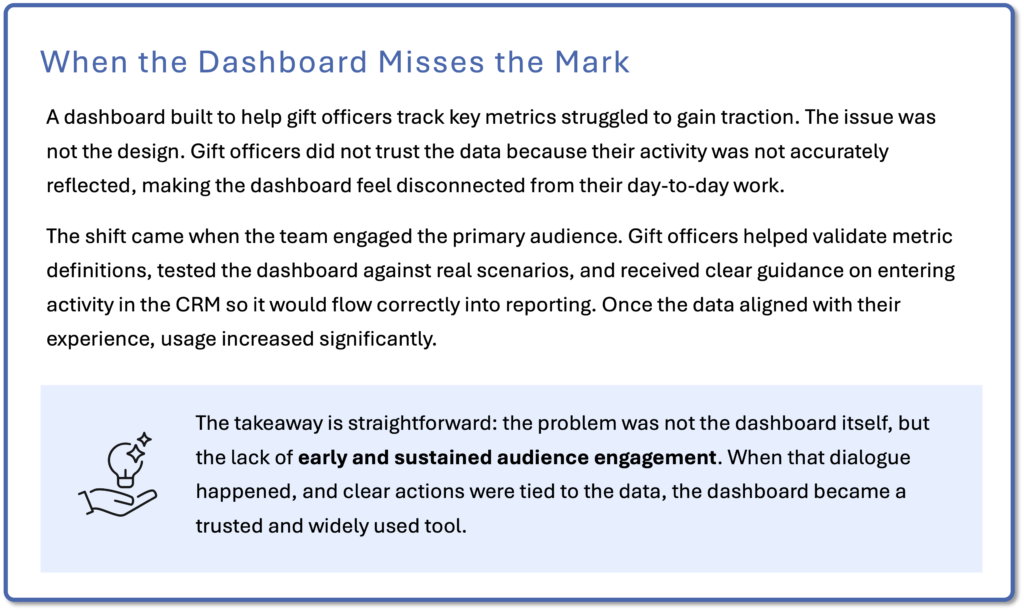
He shared a real-world example showing the cost of audience misalignment:
Decision Points Behind the Data Story
To tell a focused story, develop a clear thesis. An important point from Sam is identifying the decision point behind the data story. Are we asking questions such as:
- What decision needs to be made?
- What changes if the metric goes up or down?
- What is the one-sentence takeaway the audience should remember?
These questions help shape the narrative and keep the analysis focused on impact rather than just reporting numbers.
Data storytellers should also anticipate skepticism. Some audiences may expect external benchmarks, historical comparisons, or validation before trusting the conclusions. Sam recommended, “Provide real examples, context, and supporting evidence that strengthens credibility and makes the story more persuasive.” This way, the audience can relate to the data and how it is presented.
Story or Data: Where Does It All Begin?
One ongoing debate in data storytelling is whether the story or the data comes first. Some believe you should begin with a clear narrative and use data to support it. Others argue that you should start with the data and uncover insights naturally. In practice, effective storytelling often combines both approaches: explore the data to find meaningful patterns, then shape those insights into a story tailored to the audience’s needs.
Ultimately, successful data storytelling is not about creating the most complex visualization. It is about delivering the right message to the right audience, in a way that drives understanding and action.
Join us next as Sam and I partner to talk about assessing what data you have, what you need, and how to close the gaps.

Karen Latora
Marketing Operations Director
Advance Data Strategy

Sam Camarena
Manager, Advancement Academy
California State University, Office of the Chancellor